165 Colwill Road, Massey, Auckland
E-mail us: admin@nexuspgd.com
9:00AM - 5:00PM
Page Title BG
Hot Water Cylinder: Common Issues and Solutions

As winter arrives in Auckland, the cold isn't as harsh as it usually is, but there's still a brisk chill in the air during mornings and evenings. Perhaps due to this weather, we have seen a significant increase in inquiries about hot water cylinders and warm shower water recently.

Some customers are asking, "Why does the hot water cylinder break down on cold days rather than on not-so-cold days? I can't understand it." We'd all prefer if our hot water cylinder broke down after we've weathered the cold winter, right when spring is in the offing. However, hot water cylinders have a lifespan, too.

Generally, the main hot water cylinder lasts 10 to 15 years. Some cylinders with a shorter lifespan may break down within 5 years. If your main hot water cylinder has been operating for 20 years, it might be time to send it a small tribute. Low Pressure hot water cylinders last longer than main pressure ones, typically for about 25 to 30 years. Sometimes, you might encounter a hot water cylinder that has held up for over 30 years.When you want to melt your body with warm water in the cold weather, it is certainly a joy when hot water flows generously from the shower. However, if the water flow is weak, it can instead lead to a rise in blood pressure. Houses with weak water flow likely use Low Pressure hot water cylinders. If you want to increase the water pressure of your warm water, you might want to consider switching from a Low Pressure to a Main Pressure hot water cylinder.

However, with recent price rises, electricity costs have also become a burden. During the winter, when heating is used, electricity bills often exceed those of summer. If you are looking for a model that provides plenty of warm water while also reducing electricity costs, we recommend a gas hot water system, also widely known as the Rinnai Infinity. If you don't have natural gas (city gas) in your house, you can have gas cylinders delivered for use. This method can save you a significant amount on electricity.


1. My hot water cylinder is not hot!  

I touched the hot water cylinder in our house, and it’s not hot at all. The pipe coming out of the cylinder is hot, but is it normal for the cylinder not to be hot?

– Yes. If you’ve noticed that your hot water cylinder is not hot at all, don’t worry. This is actually normal. The hot water cylinder is essentially a kind of insulated tank that stores hot water. It is filled with insulation to effectively maintain the heat inside, so you won’t feel much heat on the outside of the cylinder. On the other hand, it’s natural for the pipes through which the water directly passes to feel hot, as they carry hot water.

2. I think our electricity bill is high because of the cylinder. We don’t need the water to be that hot. If we lower the temperature of our cylinder, will our electricity bill decrease?
    • It can indeed be burdensome if the electricity cost is high because of the cylinder. However, it’s not advisable to lower the temperature of the cylinder too much. For the health of your family, the temperature of the water stored in the cylinder should be at least 60 degrees Celsius. This is because, at lower temperatures, bacteria such as Legionella can proliferate, potentially causing diseases like pneumonia. Therefore, New Zealand building regulations stipulate that the basic temperature of the cylinder should be maintained at 60 degrees or higher to prevent the growth of such bacteria.
3. Our house uses free electricity from 9 pm to midnight. So, the family is trying to take showers at 9 pm. Will this reduce our electricity bill?
    • If you’re using free electricity from 9 pm until midnight, maximizing its usage could significantly help reduce your electricity bill. It generally takes about 2 to 3 hours for the cylinder to heat up the water. About 30% of a household’s electricity consumption typically goes to the cylinder, so if your family uses a lot of water by showering at 9 pm, the electricity required to reheat the water afterwards can be utilized for free.
4. Water is leaking from the cylinder, is this not covered by insurance?
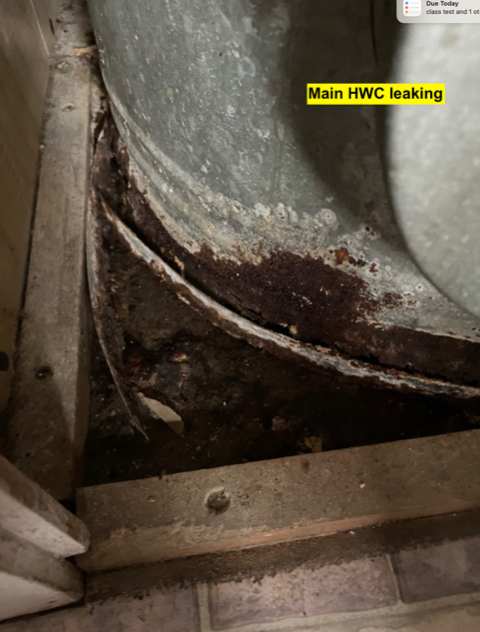
    • In cases where water is leaking from the cylinder, the cost of damage recovery can usually be claimed from insurance, but the cost of the plumber’s visit and repairs is not covered by insurance. If the cylinder has caused a problem and caused damage to the property, a plumber must first resolve the problem and write a report. This report can then be used to claim the cost of damage recovery (floor, tile, paint, wall repair costs) from insurance. However, the scope of compensation can vary depending on the terms of the insurance contract, so it would be best to consult with your insurance company for detailed information.
5. Water is dripping from the pipe that goes up to the roof.
    • If water is dripping from the pipe extending to the roof of your house, it is a phenomenon you might see in homes with a low-pressure hot water system installed. The pipe on the roof is known as an open vent. This pipe serves to release water and regulate pressure when the water in the cylinder overheats or the pressure gets too high. Therefore, occasionally releasing water is a normal phenomenon. However, if it continues to spew water, it needs to be checked by a plumber. Generally, this happens due to a fault in the pressure control device or when cold water backflows and continuously discharges hot water. If your electricity bill has suddenly surged recently, it would be a good idea to check the situation on the roof.
6. Water is falling from the cylinder. But I don’t think the entire cylinder needs to be replaced, I think just replacing the valve will be enough. Do I need to replace the entire cylinder?
    • Just because water is leaking from the cylinder, it doesn’t necessarily mean you need to replace the entire cylinder. We would recommend replacing the entire cylinder if water is leaking from the cylinder tank itself. If water is leaking to the bottom of the cylinder and has already caused damage, then you would need to replace the cylinder. However, in cases where there is a strange noise due to a faulty valve, or water is dripping a bit from the valve, you usually don’t need to replace the entire cylinder. But if the cylinder is nearing the end of its life, we would recommend replacing the entire cylinder rather than just replacing the valve. In an aging cylinder, even if you replace one valve, another valve may soon break down, and in serious cases, the cylinder can burst, covering the floor with water.

The hot water cylinder, which supplies hot water, is a complex device, and a variety of problems can occur with it. Solutions or advice may vary depending on the situation. If you have any further questions, please contact our Nexus Plumbing office (admin@nexuspgd.com).